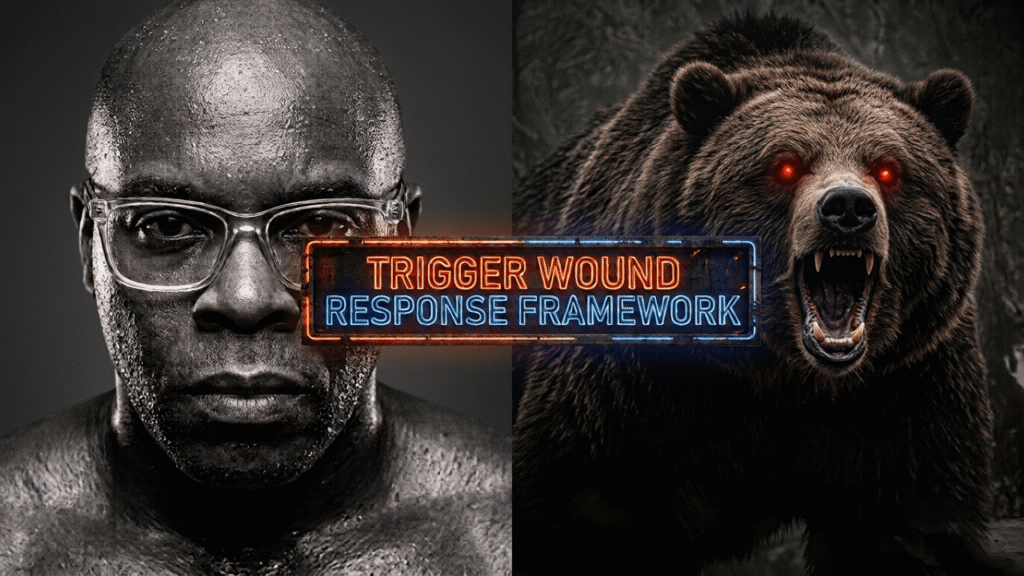
Understand Your Anger. Take Responsibility. Choose Your Response.
A conversation changes tone. You feel dismissed, criticized, or misunderstood. Before you have fully explained what bothered you, your voice rises—or you shut down completely.
Later, you wonder: “Why did I react that way?”
The Trigger–Wound–Response framework gives you three questions to explore:
What happened?
What did it touch emotionally?
What did I do—and what could I choose next time?
Developed by Ricky C. Williams, this practical reflection framework helps you examine an angry reaction, recognize patterns, and prepare a response that better reflects your values.
Anger is a signal—not a personality.
What Is the Trigger–Wound–Response Framework?
The framework organizes reflection into three connected parts:
| Step |
|---|
| The question |
|---|
| What you examine |
|---|
| Trigger |
| What happened? |
| The event, words, action, memory, or situation that activated your anger. |
| Wound |
| What did it touch emotionally? |
| The hurt, fear, expectation, value, or unmet need connected to the moment. |
| Response |
| What did I do? |
| Your words and behavior, their impact, and what you want to practice next time. |
This is a starting point for understanding your experience. It does not explain every cause of anger or require you to find a hidden wound behind every reaction.
Here, “wound” is a reflection term. It may describe a current hurt, a sensitive issue, or an earlier experience. It does not automatically mean trauma or a mental health diagnosis.
Understanding a reaction does not excuse harmful behavior. It gives you information you can use to change your choices.
Step 1: Identify the Trigger
What Happened?
Start with the moment your anger began to rise.
Perhaps someone interrupted you. Your partner changed a plan without discussing it. A coworker criticized your work. Your child ignored a request. You remembered something painful.
Describe what you observed as clearly as possible. Then identify the meaning you attached to it.
For example:
What happened: “My partner looked at their phone while I was speaking.”
What I assumed: “What I have to say does not matter.”
Both are useful to notice, but they are different kinds of information. You observed the phone use. You interpreted what it meant. That interpretation may need clarification.
Questions to Ask Yourself
What exactly was said or done?
At what moment did my anger rise?
What did I assume about the other person’s intention?
What did I expect to happen instead?
What else was affecting me—fatigue, stress, rushing, or an earlier conflict?
Put It Into Words
“When __________ happened, I interpreted it as __________.”
Naming the trigger gives you a specific moment to examine. It also helps you move away from broad accusations such as “You always disrespect me” toward something you can actually discuss.
Step 2: Explore the Wound
What Did This Situation Touch Emotionally?
Next, consider why this moment mattered to you.
Did you feel ignored? Embarrassed? Rejected? Powerless? Did it challenge a value, cross a boundary, or bring up a familiar fear?
Sometimes the hurt belongs to the present situation. Sometimes the moment reminds you of an earlier experience. You do not need to force a connection to your past for this step to be useful.
You might recognize a thought such as:
“My opinion does not count.”
“I am afraid I will be abandoned.”
“I feel exposed when someone corrects me.”
“I put in effort, and I want it to be acknowledged.”
“An agreement that matters to me was broken.”
Treat these thoughts as information about your experience. Feeling rejected does not, by itself, establish that someone intended to reject you.
Questions to Ask Yourself
Alongside anger, what else am I feeling?
What feels threatened, overlooked, or hurt?
What value, boundary, or expectation matters here?
Does this feeling seem familiar?
What do I need to communicate or clarify?
Put It Into Words
“This touched my feeling of __________ because __________ matters to me.”
If you cannot identify a deeper feeling, begin with what you know: “I am frustrated, my chest feels tense, and I need time to understand why.” You can return to the question later.
Recognizing your needs also means considering how you pursue them. Wanting reassurance, respect, or connection does not give you the right to demand obedience or control another person.
Step 3: Examine the Response
What Did You Do—and What Could You Choose Next Time?
Your response is what you said and did after the trigger.
Perhaps you raised your voice, interrupted, insulted someone, sent an angry message, or withdrew. Perhaps you paused, asked a question, or communicated a boundary.
Look at the behavior honestly and specifically. “I was upset” describes a feeling. “I shouted over my partner and called them a name” describes behavior you can take responsibility for changing.
Questions to Ask Yourself
What did I say? What tone did I use?
What did I do with my body, my phone, or my silence?
How did my response affect the other person?
Did it move me toward the outcome I wanted?
What part of my behavior needs repair?
What could I practice at the earliest warning sign next time?
Put It Into Words
“I responded by __________. The impact was __________. Next time, I will practice __________.”
A healthier response can be firm. You can disagree, say no, address unfair treatment, or end a conversation without threats or humiliation.
The goal is to make choices you can stand behind after the anger passes.
What the Framework Looks Like in Everyday Life
These examples illustrate possibilities. Your feelings and circumstances may be different.
Situation
Trigger
Possible wound or meaning
Response to practice
| At home |
| Your partner interrupts you several times. |
| “I feel unheard, and I want space to finish.” |
| “I want to hear your perspective. Please let me finish this thought first.” |
| At work |
| A colleague questions your recommendation in a meeting. |
| “I feel embarrassed and worry that my competence is being doubted.” |
| “Which part concerns you? Let’s look at it together.” |
| During a disagreement |
| Someone asks for time alone. |
| “I feel anxious and interpret distance as rejection.” |
| Respect the space and ask whether you can agree on a time to revisit the issue. |
You cannot make another person respond well. You can work on making your own words, boundaries, and actions clearer.
Create a Pause Before You Respond
Reflection is easier when you have enough space to think. If you notice yourself escalating, use this brief reset before trying to analyze the whole situation.
1. Stop
Pause the argument or message. Notice the urge to interrupt, accuse, or retaliate without immediately acting on it.
2. Settle
Relax your hands and jaw. Take a few comfortable, unforced breaths. Give yourself more time if you need it; there is no requirement to feel calm within a particular number of seconds.
3. Name
Use a simple description: “I feel embarrassed,” “I feel hurt,” or “I am too upset to listen well right now.”
4. Choose
Ask: “What outcome do I want, and what is one useful action I can take?”
That action might be a clarifying question, a respectful boundary, or a break.
You could say:
“I want to discuss this respectfully. I need a break before we continue. Can we check in again at seven?”
If you agree to reconnect, follow through or communicate that you need more time. Do not use a break to punish someone, force agreement, or avoid the issue indefinitely.
Try the Framework With One Recent Situation
Choose a situation you can reflect on without becoming overwhelmed. Write a sentence or two for each prompt:
The trigger: What happened, in observable terms?
The meaning: What did I tell myself the situation meant?
The wound: What feeling, value, expectation, or need did it touch?
The response: What did I say or do?
The impact: What happened as a result?
The next choice: What specific response will I practice next time?
Finish with one realistic commitment:
“When I notice __________, I will __________ before continuing.”
For example: “When I notice myself raising my voice, I will stop speaking, lower my volume, and ask to restart the conversation.”
You do not need to solve every pattern today. Start by recognizing one moment where a different choice is possible
Take Responsibility for Repair
If your response caused harm, understanding the wound is only part of the work.
Name what you did. Acknowledge the impact. Explain what you will practice differently, and let your behavior show the change over time.
An apology might sound like:
“I raised my voice and insulted you. That was wrong. Feeling frustrated does not excuse how I spoke. I am working on pausing earlier, and I understand that you may need time.”
Leave out the “but you made me” explanation. Respect the other person’s boundaries and their right to decide whether or when to reconnect.
Use the framework to examine your own choices. Labeling someone else’s “wound” during an argument can become another way to dismiss what they are saying.
Frequently Asked Questions
Does Every Angry Reaction Come From an Emotional Wound?
No. Anger can relate to present circumstances, frustration, unfair treatment, stress, and other factors. This framework invites exploration; it does not require a hidden hurt or a childhood explanation for every reaction.
What If the Other Person Really Was Disrespectful?
You can acknowledge their behavior and decide what boundary or action is appropriate. Taking responsibility for your response does not mean accepting mistreatment or taking responsibility for what someone else did.
Does a Calm Response Mean Staying Silent?
No. You can state a concern directly, decline a request, report a workplace issue, or leave a conversation. Calm communication can include clear disagreement and firm limits.
Can I Use This With My Partner?
You can each use it to reflect on your own experience and then share what you learned, if both people are willing. Avoid using it to diagnose, interrogate, or pressure your partner. It is not a tool for requiring someone to stay in an unsafe conversation.
What If I Only Recognize the Pattern Afterward?
Start there. Review the sequence and choose an earlier warning sign to watch for next time. The exercise can still help you identify what needs repair and what you want to practice.
Is This Framework Therapy or a Clinical Assessment?
No. It is an educational reflection tool, not a diagnosis, clinical assessment, or substitute for mental health treatment. If anger involves threats, intimidation, violence, or fear for anyone’s safety, prioritize safety and seek appropriate professional support. Do not rely on a worksheet to manage immediate danger.
A Message From Ricky C. Williams
“My work centers on helping men understand anger, strengthen communication, and take responsibility for how they respond at home and at work.
The Trigger–Wound–Response framework gives us a practical place to begin. We look at the moment that activated you, what it meant to you, and the behavior that followed. Then we identify something specific you can practice differently.
You may have learned patterns that no longer serve you. You may have made choices you regret. Those are reasons to begin the work—not reasons to give up on it.
Your next response is an opportunity to practice the person, partner, father, or leader you want to become.”
Ricky C. Williams
Certified Anger Management Coach • Certified Mediator • Author • Podcast Host
Choose Your Next Step
Begin With the Worksheet
Use the Trigger–Wound–Response Worksheet to review one recent situation, explore what it touched emotionally, and prepare a more intentional response.
Get Support Applying the Framework
If you keep returning to the same arguments or regretting the same reactions, explore coaching with Ricky C. Williams. Discuss your goals and learn whether his coaching approach fits the support you are seeking.
Only for today: notice the trigger, explore what it touches, and practice a response you can respect.