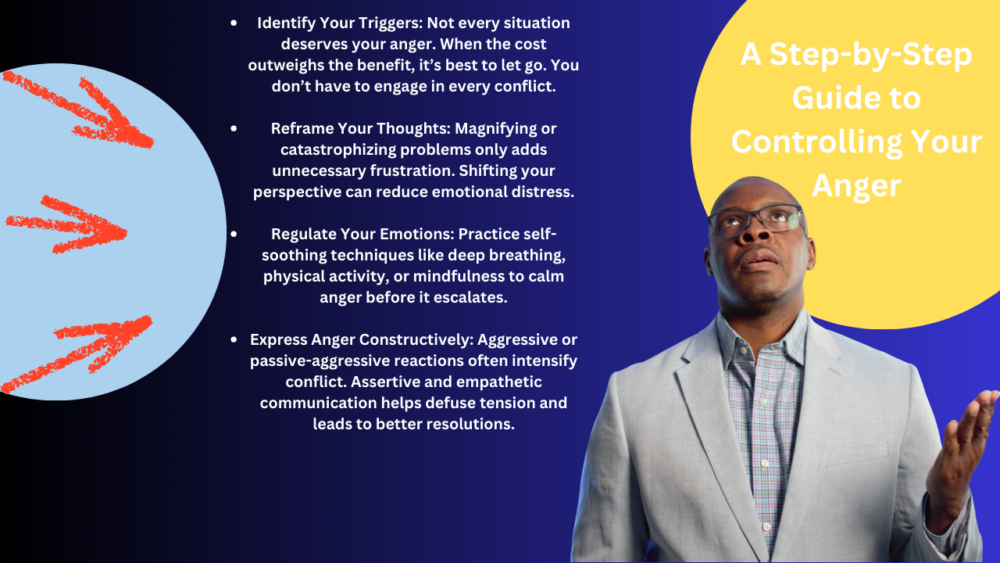
Controlling My Anger: A Step-by-Step Guide for Mastering Emotions
MEN!, I hope you enjoyed my Youtube Short! Let’s talk about that fiery little emotion we all know and sometimes love to hate – anger. Whether you’re a seasoned rage-aholic or just someone who occasionally wants to flip a table, this guide is your ticket to keeping your cool when life turns up the heat.
First things first, let’s play detective with your emotions. What sets you off faster than a firework on the Fourth of July? Is it that one coworker who chews with their mouth open? Or maybe it’s the never-ending stream of robocalls trying to reach you about your car’s extended warranty?
Take a moment to jot down your top anger triggers. It’s like creating a “Most Wanted” list for your personal irritations. Once you’ve got your list, congratulations! You’ve just taken the first step in your anger management journey. To continue on your journey Click Here
Remember when you were a kid and got sent to time-out? Well, it’s time to bring that back – but this time, you’re in charge. When you feel your anger bubbling up like a shaken soda can, give yourself permission to step away.
Here’s how to master the art of the grown-up time-out:
Recognize when you’re about to blow your top.
Politely excuse yourself. “Excuse me, I need a moment” works better than “I’m about to lose it!”
Find a quiet spot. Your car, a bathroom stall, or even a closet will do.
Take a few minutes to breathe, count to ten, or silently recite your favorite song lyrics.
Return to the situation when you feel more in control than a cat with a laser pointer.
Remember, taking a time-out isn’t running away – it’s a strategic retreat. It’s like being your own emotional firefighter, dousing those flames before they turn into a full-blown inferno.
Now, let’s talk about the most underrated superpower we all have – breathing. I know, I know, you’re thinking, “I breathe all the time, what’s the big deal?” But trust me, when it comes to anger management, breathing is like a secret weapon.
Here’s a quick breathing exercise that’ll make you calmer than a sloth on vacation:
Inhale slowly through your nose, counting to four.
Hold that breath like it’s the last slice of pizza at a party.
Exhale through your mouth, counting to six.
Repeat until you feel less like a pressure cooker about to explode.
This technique, my friends, is called “focused breathing.” It’s like hitting the reset button on your emotions. Plus, it’s a lot less embarrassing than punching a wall and pretending it doesn’t hurt.
Sometimes, anger is all about perspective. The next time you feel your temper rising, try this little mental trick I like to call “The Reframe Game.”
Here’s how to play:
Identify what’s making you angry.
Ask yourself: “Is there another way to look at this?”
Try to find a positive or neutral interpretation.
Bonus round: Can you find humor in the situation?
For example, if someone cuts you off in traffic, instead of thinking “What a jerk!”, try “Maybe they’re rushing to the hospital” or “At least they gave me a chance to practice my anger management skills!”
This technique helps you break out of negative thought patterns faster than you can say “cognitive restructuring” (which is just a fancy way of saying “think different”).

Sometimes, anger makes you feel like you’ve got more energy than a squirrel on espresso. That’s where physical activity comes in handy. It’s like a pressure release valve for your emotions.
Here are some ways to channel that angry energy:
Go for a brisk walk (bonus points if you power walk like you’re in the Anger Olympics)
Do some jumping jacks (pretend you’re trying to high-five the sky)
Punch a pillow (much better than punching a wall – trust me, your hand will thank you)
Dance it out (angry dancing is totally a thing, just ask your favorite teen drama)
The goal is to get your body moving and your heart pumping. It’s like you’re physically pushing the anger out of your system. Plus, exercise releases endorphins, which are like nature’s chill pills.
Often, anger is just frustration in a trench coat trying to look tough. Learning to communicate effectively can be your secret weapon in defusing tense situations.
Try using “I” statements instead of “You” accusations. For example:
Instead of: “You never listen to me!”
Try: “I feel frustrated when I’m not heard.”
It’s like the difference between throwing a verbal grenade and extending an olive branch. One leads to World War III, the other to potential peace talks.
Here’s a wild idea: what if your anger issues are just you being a cranky toddler who needs a nap? Getting enough sleep is crucial for managing your emotions. When you’re well-rested, you’re less likely to snap at someone for breathing too loudly.
Aim for 7-9 hours of sleep a night. It’s like putting your emotions through a car wash – everything comes out cleaner and shinier on the other side.
7 F.A.Q’s on Controlling My Anger Like A Pro
You may not be able to stop anger from showing up, but you can learn to keep it from controlling what you do next. Start by noticing your early warning signs, such as a tight chest, a raised voice, or the urge to interrupt. Pause, slow your breathing, and give yourself a few minutes before continuing the conversation. Then ask, “What happened, what am I telling myself it means, and what response would help?” That pause gives you room to address the problem without making it worse.
There is no single emotion behind anger. Sometimes you are angry because a boundary was crossed or something important feels unfair. Other times, anger comes alongside hurt, fear, embarrassment, grief, or feeling unheard. A useful question is, “If I set the anger aside for a moment, what else am I feeling?” Naming that feeling can help you explain what you need instead of expecting someone else to figure it out.
Anger is a normal emotion, so the goal is to change patterns that are harming you or your relationships. Begin by tracking three things after an angry moment: the trigger, the thought you had about it, and your response. CBT-based strategies help you test thoughts that intensify anger and practice a more useful response. If outbursts are frequent, frightening, or difficult to control, a licensed mental health professional can help you assess what is happening and build a treatment plan. dictionary.apa.org
A small event can set off a strong reaction when you are already stressed, exhausted, or carrying an unresolved concern. Your interpretation matters, too. For example, a delayed reply may feel like disrespect when you are already worried about being ignored. Before reacting, ask yourself, “What happened, and what meaning did I give it?” The answer can help you respond to the real concern instead of only the latest irritation.
Anger itself is not a mental illness. It is a normal emotion, even when it is intense. Frequent or severe outbursts can, however, be a reason to seek an assessment, especially if they involve aggression or disrupt daily life. A qualified clinician can explore whether a mental health condition, another health concern, or a learned response pattern is contributing. Avoid diagnosing yourself from a single symptom. apa.org
Start by being honest about the injury or belief keeping the hate active. Letting go does not require you to excuse what happened, forgive someone, or reconnect with them. It means deciding how much space the experience will occupy in your thoughts and choices today. When a painful thought returns, ask, “Is this thought helping me take action, or keeping me stuck in the same moment?” Set boundaries where needed and put your energy toward the life you want to build.
Anger can arise when you perceive a threat, an injustice, a blocked goal, or a violation of something you value. Stress and your interpretation of an event can affect how strongly you react. In my Trigger–Wound–Response framework, the trigger is what happened, the wound is the personal meaning or pain it touched, and the response is what you choose to do next. Understanding all three helps you address the cause while taking responsibility for your behavior.
Remember, managing your anger isn’t about never getting angry. It’s about handling your anger in a way that doesn’t make you want to crawl into a hole and hide the next day. It’s about being the boss of your emotions, not the other way around. Get the help you deserve!


