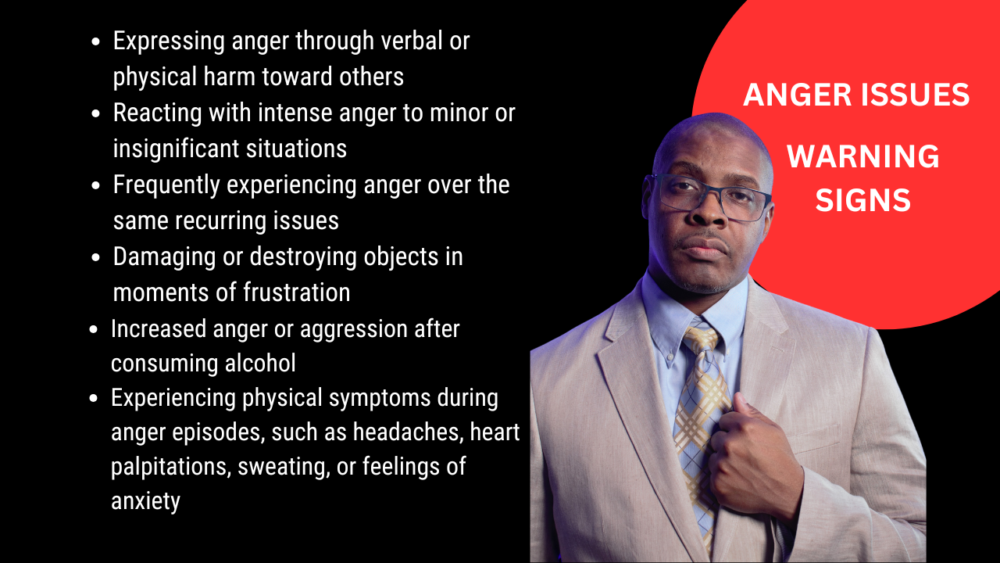
10 Signs Of Anger Issues In Men You Should Recognize
MEN, Let’s Talk! Hope you enjoyed the Youtube Short! Let’s talk about something that can really put a damper on your relationship: anger issues. We’ve all been there – that moment when you’re seeing red and suddenly your partner looks more like a target than your better half. But how do you know if it’s just a bad day or if there’s a deeper issue brewing? Well, grab your favorite stress ball (or your partner’s hand) and let’s dive into the 10 signs you might have anger issues. If you need immediate help click here
1.
You know that feeling when you’re like a ticking time bomb, ready to explode at the slightest provocation? Yeah, that’s not just you being “passionate.” If you find yourself constantly irritated, it’s like you’re walking around with a “Do Not Disturb” sign permanently stuck to your forehead. This persistent irritability is often a telltale sign that you might be dealing with some anger management issues.
2.
We’ve all had those moments where we lose our cool, but if you’re regularly turning into the Incredible Hulk (minus the cool green skin), it might be time to take a step back. Frequent outbursts of intense anger that seem way out of proportion to the situation at hand are a big red flag. If your partner’s asking “Why are you yelling?” more often than “How was your day?”, Houston, we have a problem.
3.
Ah, passive-aggression – the art of being angry without actually saying you’re angry. If you find yourself constantly giving the silent treatment, making snarky comments, or “forgetting” to do things your partner asked, you might be dealing with some unresolved anger issues. It’s like you’re playing emotional chess, but nobody’s winning.
4.
Do you often find yourself in this cycle: get angry, say or do something you regret, apologize, repeat? If your “I’m sorry” speeches are becoming more frequent than your “I love you”s, it might be time to address those anger issues. Constantly regretting your actions when you’re angry is a sign that your anger is controlling you, not the other way around.
5.
If you’re losing your cool over little things like your partner leaving a dirty dish in the sink or forgetting to text you back immediately, you might be dealing with some anger management issues. When every minor irritation feels like a personal attack, it’s a sign that your anger meter might be a little out of whack.

6.
Do you find yourself constantly pointing fingers? If your go-to response in any conflict is “It’s not my fault, it’s yours/theirs/the universe’s,” you might be using anger as a shield. Blaming others for your feelings or actions is often a sign of underlying anger issues that need addressing.
7.
Anger isn’t just a mental state – it can manifest physically too. If you’re constantly dealing with tension headaches, a racing heart, or feeling physically exhausted after arguments, your body might be trying to tell you something. These physical symptoms can be your body’s way of saying, “Hey, we need to deal with this anger stuff!”
8.
If your relationship is starting to feel less like a rom-com and more like a war movie, it might be time to wave the white flag on those anger issues. Constant conflict, feeling like you’re walking on eggshells, or noticing that your partner seems afraid to bring up certain topics are all signs that anger might be taking a toll on your relationship.
9.
Can’t let go of that thing your partner did three years ago? Still fuming about that comment your in-law made last Thanksgiving? If you’re holding onto anger like it’s your most prized possession, it might be a sign of deeper anger issues. Chronic resentment can be like a slow poison for relationships.
10.
If you find yourself constantly feeling like the victim, like the world (and especially your partner) is out to get you, it might be time for a reality check. This kind of victim mentality often goes hand-in-hand with unresolved anger issues.
7 FAQ’s About Anger Issues In Men
1. What causes anger issues in men?
Anger issues in men rarely have one cause. Anger may arise when a man feels threatened, treated unfairly, overwhelmed, or unable to express what he needs. Stress and past experiences can also shape his reaction. In my coaching work, I encourage men to examine the trigger (what happened), the wound (why it felt personal), and the response (what they did next). Understanding that pattern creates an opportunity to respond differently.
2. How do I know if my anger has become a problem?
Anger deserves attention when your reactions repeatedly damage relationships, create problems at work, or leave you regretting what you said or did. Warning signs may include frequent shouting, intimidation, breaking objects, or feeling unable to stop once an argument begins. You do not have to wait for a crisis to seek support.
3. Why do I get angry over things that seem small?
A small event can feel much bigger when it touches an existing frustration or belief. For example, an interruption may bring up the thought, “No one respects what I have to say.” A CBT-informed approach is to separate the event from the meaning you gave it: What happened? What did I assume it meant? Is there another reasonable explanation? This helps you address the actual concern without letting one moment define the whole conversation.
4. How can a man control his anger in the moment?
Start by recognizing your early warning signs, such as a tense jaw, faster breathing, or the urge to raise your voice. Pause and say, “I need a few minutes to calm down. I’ll come back so we can finish this.” During the break, slow your breathing and avoid rehearsing the argument in your head. When you return, describe the issue and what you need without attacking the other person. Taking a timeout and communicating more clearly are established anger management strategies.
5. Is anger in men always a sign of a mental health condition?
No. Anger is a normal human emotion, and feeling angry does not by itself mean someone has a mental health condition. If outbursts are severe, frequent, aggressive, or difficult to control, a licensed mental health professional can assess what is contributing and recommend appropriate care. A coach can help you practice skills, but a clinical diagnosis requires a qualified clinician.
6. Can anger management or CBT help men with anger issues?
Yes. Anger management teaches practical skills such as identifying triggers, calming your body, communicating directly, and handling conflict. CBT goes further into the connection between your thoughts, feelings, and actions. For example, you can learn to test the thought “He embarrassed me on purpose” before acting on it. These skills take practice, but change is possible.
7. When should a man seek professional help for anger?
Seek help when anger is affecting your partner, children, friendships, work, or sense of control. If your behavior includes threats, intimidation, violence, or fear that you may hurt someone, contact a licensed mental health professional promptly and prioritize everyone’s safety. Asking for help is a concrete step toward taking responsibility and learning a different way to respond
5 Take a Ways For Anger Issues In Men
Now, I know what you’re thinking: “Great, so I might have anger issues. What the heck do I do about it?” Well, first off, take a deep breath. Recognizing the problem is half the battle won. Here are a few steps you can take:
Talk to your partner: Open up about what you’re experiencing. They might have insights you haven’t considered.
Consider anger management classes: These can be super helpful in learning techniques to manage your anger.
Try mindfulness techniques: Apps like Calm or Headspace can be great for this.
Seek professional help: A therapist can work wonders in helping you understand and manage your anger.
Practice self-care: Sometimes, anger is a sign that we’re not taking care of ourselves. Make sure you’re getting enough sleep, exercise, and me-time.
Remember, having anger issues doesn’t make you a bad person or a bad partner. It’s a challenge, sure, but it’s one that you can overcome with the right tools and support. Your relationship (and your blood pressure) will thank you for it.
So, there you have it – 10 signs you might have anger issues, served up with a side of humor and a sprinkle of hope. Because let’s face it, life’s too short to spend it angry, and love’s too precious to let anger get in the way. Now, go hug your partner (or your stress ball) and start your journey to a calmer, happier you!

